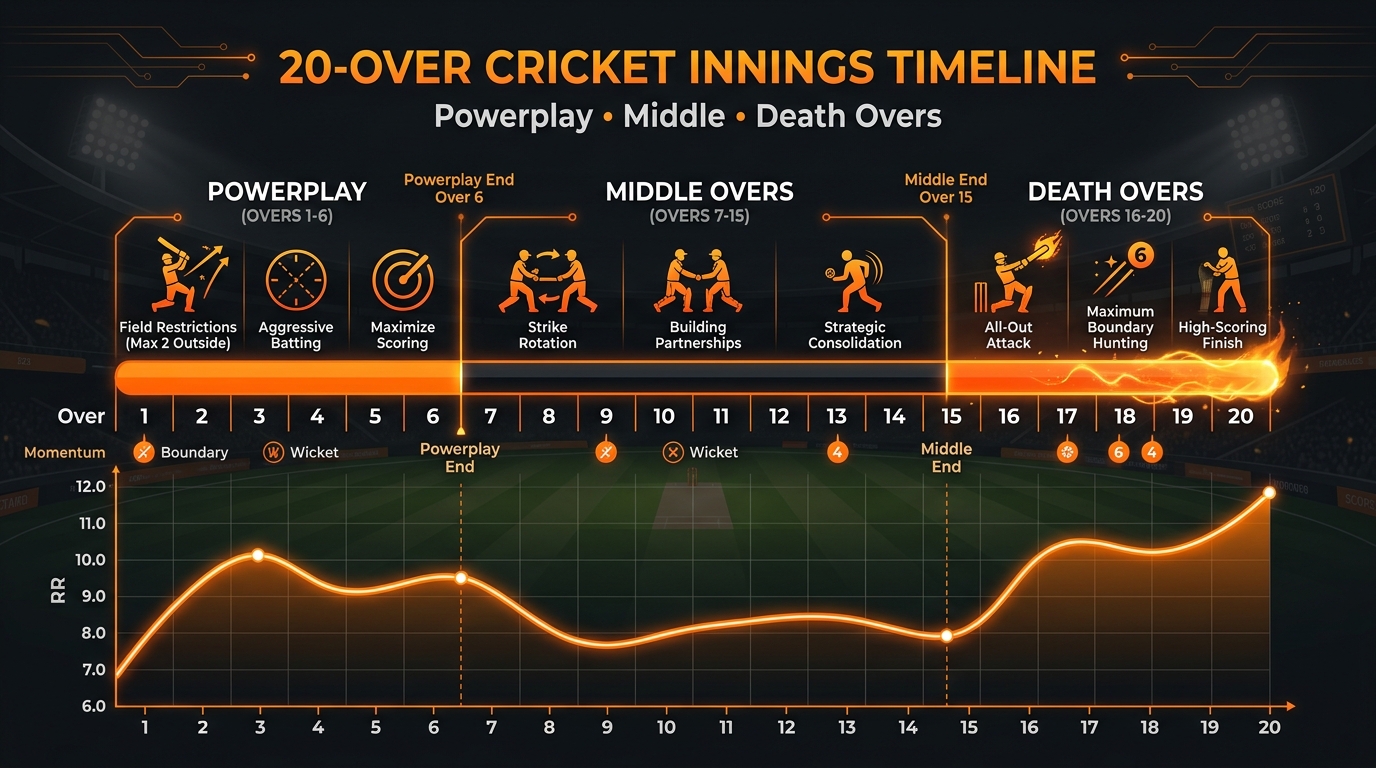
A T20 innings is not 20 identical overs — it has a clear rhythm. Teams plan their batting and bowling around three broad phases, and recognising them transforms how you watch the game. Once you know what each phase is for, you can understand why a team is attacking, consolidating or going all-out.
Phase 1: The powerplay (roughly the first 6 overs)
The powerplay is the opening phase, during which fielding restrictions limit how many fielders can be placed outside the inner circle. With gaps to exploit and fewer protectors on the boundary, batters look to score quickly while the field is up. The bowling side, meanwhile, tries to take early wickets to slow the scoring. A fast powerplay can set up a huge total; an early collapse can put a team on the back foot for the rest of the innings.
Phase 2: The middle overs (roughly overs 7–15)
Once the fielding restrictions ease, more fielders move to the boundary, and scoring usually slows. This is the consolidation phase. Batting sides aim to keep wickets in hand and rotate the strike with singles and twos, picking off the occasional boundary, while building a platform to attack later. Spin bowling often features here, which is where the pitch can have a big say. The middle overs are less explosive but often decide whether a team can launch at the end.
Phase 3: The death overs (roughly the last 5 overs)
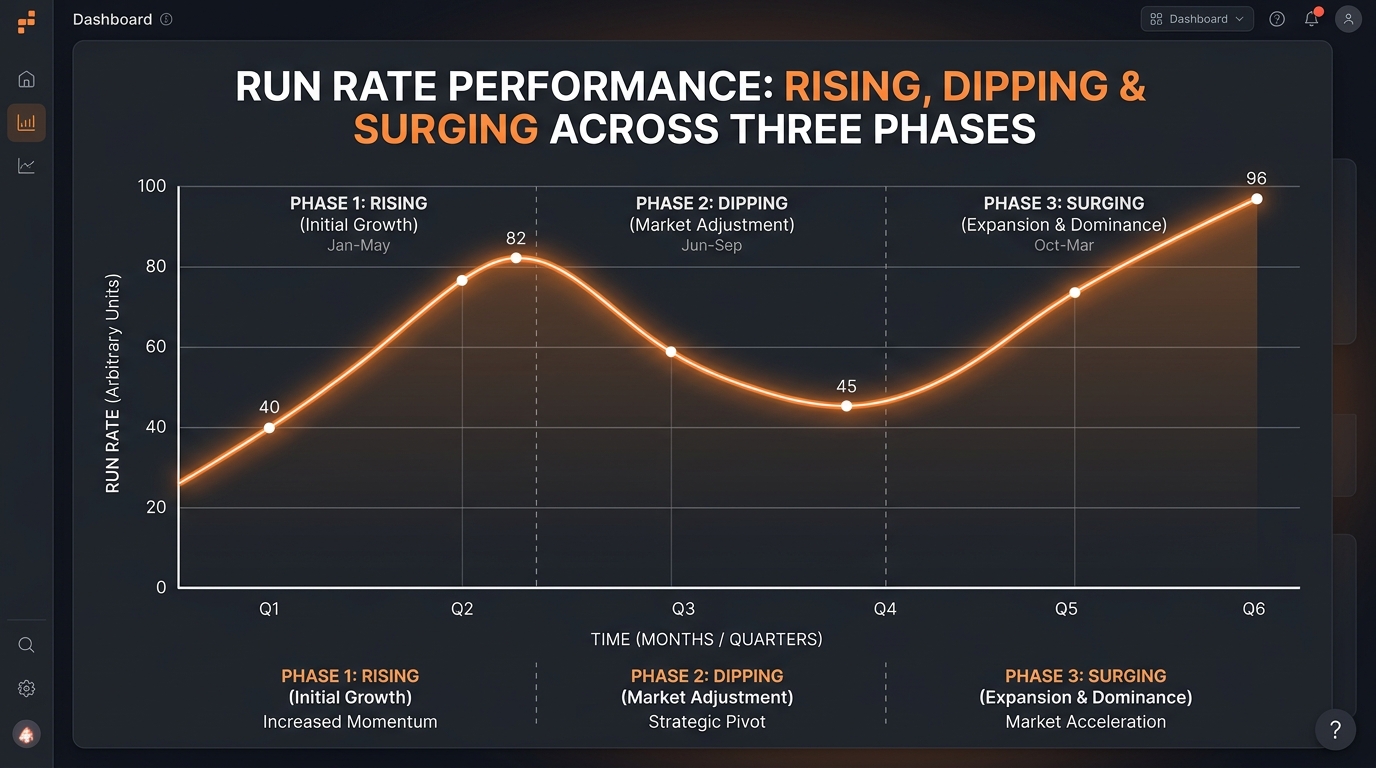
The death overs are the final, frantic phase. With the innings running out, batting sides throw caution aside and aim to maximise every ball. Run rates climb sharply, and big hitting is the norm. For bowlers it is the hardest phase: they rely on yorkers, slower balls and clever variations to limit the damage. The death overs are often where matches are won or lost, and where the scoreboard can move dramatically in a single over.
Why the phases matter when following a match
Knowing the phases helps you judge whether a score is good. A team that is 50 without loss after the powerplay is well placed; the same score with three wickets down is under pressure. It also explains the natural rhythm of a run chase. Because scoring speeds up and slows down predictably, the phases are central to session and fancy markets, which often focus on runs in a specific block of overs. For anyone watching live cricket, the phase the game is in is essential context for why odds are moving.
A quick note on chasing
When a team is chasing, the phases interact with the required run rate. A side might absorb pressure through the middle overs, trusting that wickets in hand will let them accelerate at the death. Whether that gamble pays off depends on the pitch, the bowlers and the batters at the crease — another reminder that cricket rewards reading the situation rather than assuming. A chasing side that loses early wickets may have to rebuild through the middle overs and gamble everything at the death, while a flying start can let them cruise home with overs to spare. Either way, the phase the chase is in tells you most of what you need to know about the pressure on the batters at the crease.
Frequently asked questions
How long is the powerplay in T20?
The fielding-restriction phase covers roughly the first six overs of a T20 innings, during which fewer fielders are allowed outside the inner circle.
Why do runs slow in the middle overs?
Once the early restrictions ease, more fielders patrol the boundary, so batters often rotate the strike and pick gaps rather than attack every ball.
What makes the death overs so hard to bowl?
Batters attack almost every delivery, so bowlers rely on yorkers, slower balls and clever variations to limit the damage.
Do ODIs have phases too?
Yes. A 50-over innings has a similar rhythm — an early powerplay, a long middle phase for building, and a final acceleration.
Key takeaways
- A T20 innings has three phases: powerplay, middle overs and death overs.
- The powerplay favours fast scoring thanks to fielding restrictions.
- The middle overs are about consolidation and keeping wickets in hand.
- The death overs see the highest scoring and the most pressure on bowlers.
- The phases are key context for session markets and live odds.
Understanding the phases helps you follow the game, but cricket is unpredictable and nothing is guaranteed. If you bet, do so as an adult within a set budget and never chase losses.
Watch the phases unfold
The rhythm of an innings is clearest when you follow it live. See how real-time cricket works on FairPlay.
Explore FairPlay Live