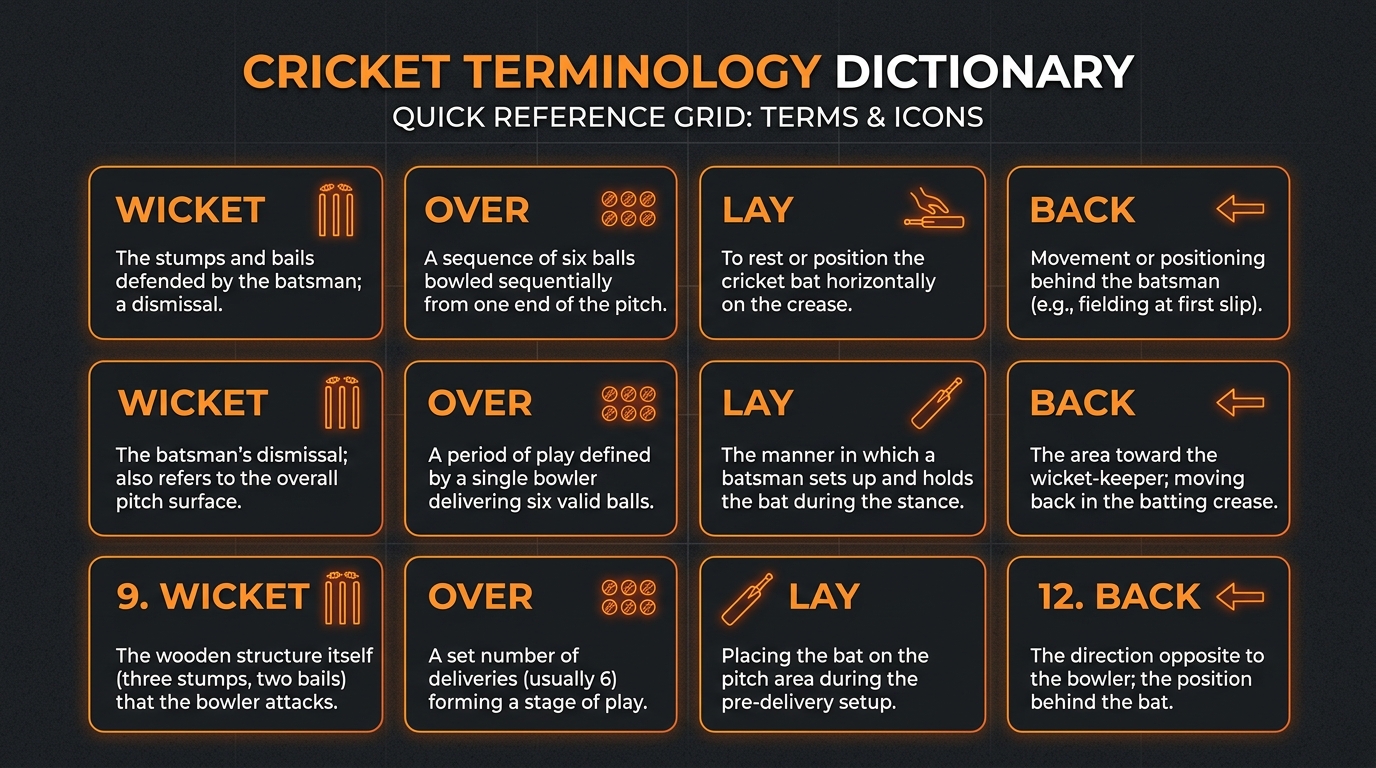
Cricket and betting both come with their own vocabulary, and the two overlap in ways that can confuse newcomers. This glossary gathers the most common terms in one place, explained in plain English. Bookmark it and come back whenever you hit a word you do not recognise.
Exchange and betting terms
Back: A bet that an outcome will happen. Backing a team means you win if they win. See our full guide to back and lay betting.
Lay: A bet that an outcome will not happen. Laying means you act like the bookmaker for that selection and take on a liability.
Liability: The amount you could lose on a lay bet if the outcome you bet against actually occurs. Always check it before confirming.
Odds (decimal): The total return per ₹1 staked, including your stake. Odds of 2.0 return ₹2 for every ₹1. Learn more in how to read cricket odds.
Stake: The amount of money you put on a bet.
Matched / unmatched bet: A matched bet has been paired with an opposing bet and is live; an unmatched bet is still waiting for someone to take the other side. See the order book explained.
Order book / market depth: The list of prices and amounts available to back and lay a selection.
Liquidity: How much money is available in a market. High liquidity means easier matching at fair prices.
Cash out: Settling a bet early for a value based on current odds, to lock in profit or cut a loss. See what cash out is.
Commission: A small fee an exchange typically charges on net winnings.
In-play (live) betting: Betting while the match is in progress, with odds updating ball by ball.

Cricket market terms
Match odds: The main market on who wins the match.
Bookmaker market: An alternative match-winner market with its own prices.
Fancy / session markets: Bets on parts of the game, such as runs in a set number of overs. See match odds, bookmaker and fancy markets.
Toss: The pre-match coin flip that decides which captain chooses to bat or bowl first.
Cricket gameplay terms
Over: A set of six legal deliveries bowled by one bowler.
Powerplay: An early phase with fielding restrictions that encourages scoring. See the phases of a T20 innings.
Death overs: The final overs of an innings, often the highest-scoring and highest-pressure phase.
Run rate: The average number of runs scored per over.
Required run rate: The runs per over the chasing team needs to win.
Strike rate (batting): Runs scored per 100 balls faced — a measure of scoring speed.
Economy rate (bowling): Runs conceded per over — lower is better for the bowler.
Maiden over: An over in which no runs are scored off the bat.
Wicket: The dismissal of a batter; also the term for the stumps and the pitch itself.
All-rounder: A player who contributes meaningfully with both bat and ball.
DLS method: A calculation used to set or adjust targets in rain-affected limited-overs matches.
For the stats in more detail, see key cricket stats every fan should understand.
More terms worth knowing
No-ball: An illegal delivery (for example, overstepping the crease) that gives the batting side an extra run and, often, a free hit.
Wide: A delivery too far from the batter to play a normal shot; it adds a run and must be re-bowled.
Free hit: The delivery after a front-foot no-ball, on which the batter cannot be dismissed by most methods.
Yorker: A delivery pitched right at the batter's feet, used heavily in the death overs to limit scoring.
Googly: A wrist-spinner's variation that turns the opposite way to the batter's expectation.
Duck: A batter being dismissed without scoring a run.
Boundary: A four (ball reaches the rope along the ground) or a six (ball clears the rope on the full).
Net run rate (NRR): A tie-breaker in league tables reflecting how heavily a team has won or lost across a tournament.
Key takeaways
- Back and lay are the two core exchange actions; liability is the risk on a lay.
- Decimal odds show total return including your stake.
- Match odds, bookmaker and fancy are the main cricket market types.
- Strike rate, economy and run rate are the most useful gameplay stats.
Knowing the terms makes betting clearer, but it does not reduce the risk. Betting is for adults aged 18 and over — set a budget and only stake what you can afford to lose.
Now put the words to work
Once the vocabulary makes sense, the markets are much easier to follow. Explore how it all fits together on FairPlay.
Explore FairPlay